
Potability Assessment: How many parameters to test?
Many people wonder which, or how many, parameters must be tested to check potability. The short answer is, it depends. The number of tests depends on the characteristics of the source, the credibility and reliability of the water treatment and distribution system in question, and access to alternative sources for drinking water. A 'potable' status is determined by testing for high-risk, locally relevant contaminants rather than a comprehensive, all-parameter screen. For a new water source, a comprehensive scan is recommended, but for routine monitoring, a targeted, risk-based approach is sufficient.
The Indian standard specification for drinking water quality (IS 10500, 2012) lists 64 parameters, including 2 bacteriological parameters, 6 organoleptic and physical parameters, 24 general chemical parameters, 12 toxic substances, 18 pesticide residues, and 2 radioactive substances. Inclusion in the standard specification does not mean that all 64 quality parameters have to be tested all the time. A risk-based approach is appropriate. The choice of parameters for monitoring and verification of quality is to be based on the reliability of the source, variability of parameter values, prevalence of attributable risk, consumer concerns, and clues leading to suspicious contamination. In this context, the criticality of health risk and cost-effectiveness are key considerations.
The Government of India (GOI) departments concerned with drinking water have, from time to time, set key parameters for monitoring and surveillance purposes (Table 1). The Implementation Manual on National Rural Water Quality Monitoring & Surveillance Programmes (GOI-DDWS, 2004) identified 10 essential parameters (Turbidity, pH, Hardness, Chloride, Iron, Nitrate, Fluoride, Residual Chlorine, Arsenic, and Bacteriological quality) for field testing by community-based water quality surveillance programs. The National Rural Drinking Water Programme – Guidelines (GOI-MoWDS, 2013a) identified 12 parameters of potability (pH, Arsenic, Fluoride, E. coli, Nitrate, Iron, Calcium, Magnesium, Sulphate, Alkalinity, and Turbidity). The Uniform Drinking Water Quality Monitoring Protocol issued by the Government of India in the same year (GOI-DDWS, 2013b) identified 13 basic minimum parameters that need to be tested for drinking water quality. These are: pH, Turbidity, TDS, Total Hardness, Alkalinity, Fluoride, Chloride, Sulphate, Nitrate, Arsenic, Iron, Total coliforms, and E. coli. Later, the number of basic water quality parameters was increased to 16 by including Colour, Odour, and Residual Chlorine (GOI-DDWS, 2021). The number of parameters in most of the IHS Laboratory test packages dealing with the potability question ranges from 13 to 24.
Table-1: Key Drinking Water Quality Parameters for Monitoring and Surveillance set by the Government of India from time to time.
| Sl | NRWQ Monit. & Surv. Pgm.Natl. Rural Water Qlt. Monit. & Surv. Pgm.National Rural Water Quality Monitoring & Surveillance Program (DDWS, 2004) | Natl. DW Pgm. GuideNatl. DW Pgm. GuidelinesNational Rural Drinking Water Program Guidelines (MoDWS, 2013a) | Unif. DWQ Monit. Prot.Unif. DWQ Monit. ProtocolUniform Drinking Water Quality Monitoring Protocol (MoDWS, 2013b) | DWQ Monit. & Surv. Frmwk.DW Qlt. Monit. & Surv. FrameworkDrinking Water Quality Monitoring & Surveillance Framework (DDWS, 2021) |
|---|---|---|---|---|
| Colour | ||||
| Odour | ||||
| Turbidity | Turbidity | Turbidity | Turbidity | |
| pH | pH | pH | pH | |
| TDS | TDS | TDS | ||
| Alkalinity | Alkalinity | Alkalinity | ||
| Hardness | Hardness | Hardness | ||
| Calcium | ||||
| Magnesium | ||||
| Nitrate | Nitrate | Nitrate | Nitrate | |
| Chloride | Chloride | Chloride | ||
| Sulfate | Sulfate | Sulfate | ||
| Iron | Iron | Iron | Iron | |
| Fluoride | Fluoride | Fluoride | Fluoride | |
| Arsenic | Arsenic | Arsenic | Arsenic | |
| Total coliforms | Total coliforms | |||
| Bacteriological quality | E. coli | E. coli | E. coli | |
| Residual Chlorine | Residual Chlorine | |||
|
1GOI-DDWS, 2004. Community Based Water Quality Surveillance, Chapter-10 in Implementation Manual on National Rural Water Quality Monitoring & Surveillance Programme. New Delhi: Govt of India Ministry of Rural Development, Dept of Drinking Water Supply (DDWS); 2004 Nov. 2GOI-MoDWS. Annex.D, p41 in National Rural Drinking Water Programme - Guidelines. New Delhi: Govt of India Ministry of Drinking Water & Sanitation (MoDWS); 2013. Available at https://www.ielrc.org/content/e1308.pdf 3GOI MoDWS, 2013. Uniform Drinking Water Quality Monitoring Protocol. New Delhi: Govt. of India Ministry of Drinking Water and Sanitation (GOI MoDWS); 2013 Feb. 4GOI-DDWS. 2021. Basic water quality parameters, p14 in Drinking Water Quality Monitoring & Surveillance Framework. New Delhi: Govt. of India Ministry of Jal Shakti, Department of Drinking Water and Sanitation (GOI DDWS); 2021 Oct. |
||||
"Does it mean that if the set of basic parameters for potability is within IS 10500 limits, the water is potable? Not necessarily. If the water complies with the basic set or essential list of physical, chemical, and, most importantly, microbiological parameters, it is generally considered safe for drinking. However, meeting the ‘basic’ parameters does not guarantee 100% safety if source characteristics or an overview of multiple parameters indicate a high risk of contamination. In such situations, a public health opinion of ‘unfit for drinking’ or ‘conditionally fit for drinking’ would be appropriate.
Another pertinent question would be, "Why would the IS 10500 list 64 parameters when fitness for drinking can be decided on the basis of test results for a list of 10 to 16 essential or basic parameters of potability?" The answer lies in the fact that the comprehensive list allows for monitoring in diverse areas all over the country. For example; while arsenic contamination of groundwater is prevalent in eastern alluvial plains like West Bengal, fluoride affects groundwater in hard-rock regions like Telangana. It includes some water quality parameters that indicate treatment efficiency but do not have adverse health effects, for example, residual chlorine. The Water Treatment Plants (WTP) are expected to test all parameters of source water to design the treatment system. A large subset of all parameters in IS 10500 are tested at least annually, and smaller subsets of water quality parameters are tested according to WTP and distribution system operation guidelines. A smaller set of parameters are tested daily. For example, the CPHEEO (2023) Manual on Water Supply and Treatment Systems Part B - Operation & Maintenance specifies that six parameters (colour, odour, turbidity, EC, TDS, and faecal coliforms) should be tested daily at the inlet point of water sourced from surface water bodies, and seven (inlet-6 + residual chlorine) parameters should be tested at the WTP outlet point. Aluminum is to be tested once a month, and the periodicity of testing for other metals should be decided by the concerned water utility based on source characteristics. Five parameters (Turbidity, EC/TDS, pH, E. coli, Residual Chlorine) should be tested at the inlet and outlet points of water utility transmission/distribution reservoirs daily.
The declaration of potability (fitness for drinking) in IHS Lab water quality test reports is the opinion of a public health specialist in circumstances of each case. The public health opinion is based on test results, source characteristics and intended use cases. In our experience, most samples of municipal supply and purified water, many deep borewell water samples are assessed as potable. However, significant number of samples from various sources are assessed as unfit for drinking, based on source characteristics and one or more test parameters. The following categories of ‘unfit-for-drinking’ reports give an idea of the nature of potability assessment decisions.
- Occasionally, definite opinion about potability is withheld or ‘unfit for drinking’ opinion is given based on source characteristics, even if all tested parameters are within IS 10500 limits.
- Sometimes ‘unfit for drinking’ opinion is given based on sensory characteristics such as colour and/or odour, even if all other tested parameters are within IS 10500 limits.
- Most often ‘unfit for drinking’ opinion is based on bacteriological analysis showing signs of faecal contamination, even if tested physical-sensory & general chemical parameters are within IS 10500 limits. A review of 241 samples with client concerns about potability, reported during first semester of 2025, showed that ‘unfit for drinking on account of faecal contamination’ opinion was given in 24 (≈ 10%) reports.
- Sometimes signs of faecal contamination may be seen along with an impermissible physical or general chemical parameter such as fluoride, nitrate, turbidity or hardness. Five such cases (≈ 2%) turned up in the review of 241 potability related test reports.
- Even if, bacteriological analysis does not show any sign of faecal contamination, unfit for drinking opinion is given based on a single physical or chemical parameter that exceeds IS 10500 limits. About 6% (15) of the 241 samples with client concerns about potability, were in this category. The single parameters leading to unfit for drinking opinion were, nitrate (6 cases), fluoride (5 cases) and hardness (4 cases).
- We do also come across several cases of multiple test parameters being off-limit. An unfit for drinking opinion is obvious in such cases. About 3% (7) of the 241 samples with client concerns about potability, were in this category. Five of these cases were identified as unfit on account of two parameters, such as (i) disagreeable odour & excess ammonia, (ii) high TDS & turbidity, (iii) high alkalinity & high pH, (iv) excessive hardness & magnesium, and excessive hardness & marginally higher nitrate.
The case of disagreeable odour and excess ammonia is noteworthy. The following opinion was offered to the client:
The presence of total coliforms in the presence of ammonia could be due to faecal/sewage contamination. Although, faecal coliforms were absent in this sample, it would be desirable to repeat testing two or three times to establish safety characteristics of the borewell water. Repeat tests should be done after pumping and using the borewell water for gardening or outdoor cleaning.
Two of the 241 cases were found unfit on account of more than two parameters. In one case, several general chemical parameters—such as TDS, hardness, calcium, magnesium, and chloride—exceeded acceptable limits, while alkalinity and nitrate exceeded permissible limits. In the other case, turbidity, iron and manganese were beyond the permissible limit.
Potability Assessment - Case Studies.
Cases in which ‘unfit for drinking’ opinion was given or definite opinion about potability was withheld based on source characteristics, even if all tested parameters were within IS 10500 permissible limits:
Case-01, Unusually low mineral content in a sample of sumped municipal water:
The maintenance office of a gated community in Hyderabad brought a sample of municipal water stored in a sump. The sample was collected from the sump by dipping an empty packaged water bottle. The client wanted to check if the water was fit for drinking. Laboratory units reported following results:
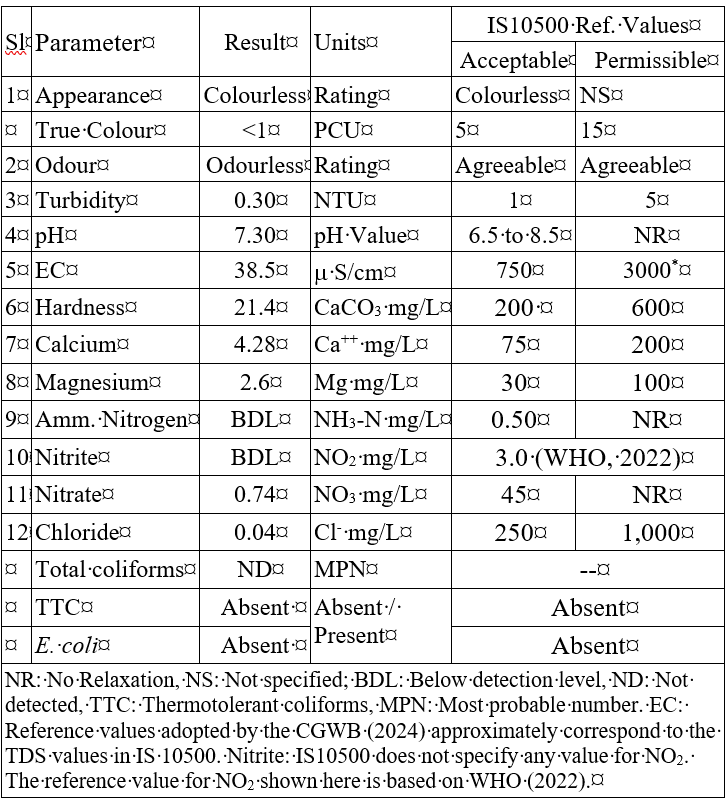
This is a case where physical and sensory characteristics as well as tested general chemical parameter values were within acceptable/permissible limits. No coliform was detected in bacteriological analysis, indicating no faecal contamination. However, opinion about potability of ‘sumped municipal water’ was withheld and the following opinion was provided to the client.
- Mineral content of Metro water in Hyderabad, observed by this laboratory, is usually higher than what is observed in this case. The Low mineral content of the sample is consistent with what we usually find in RO purifier water and rain water harvest samples. The sample might have been mislabeled.
- It would be desirable to correctly identify the source, in order to interpret test result for intended use cases.
Case-02, Chemical smell in borewell water from a farmhouse:
A groundwater sample from a 1.5-year-old deep borewell was brought in by a client from a farmhouse. The sample was collected in an empty packaged water bottle. The client reported a chemical smell in the borewell water. Laboratory units reported following results:
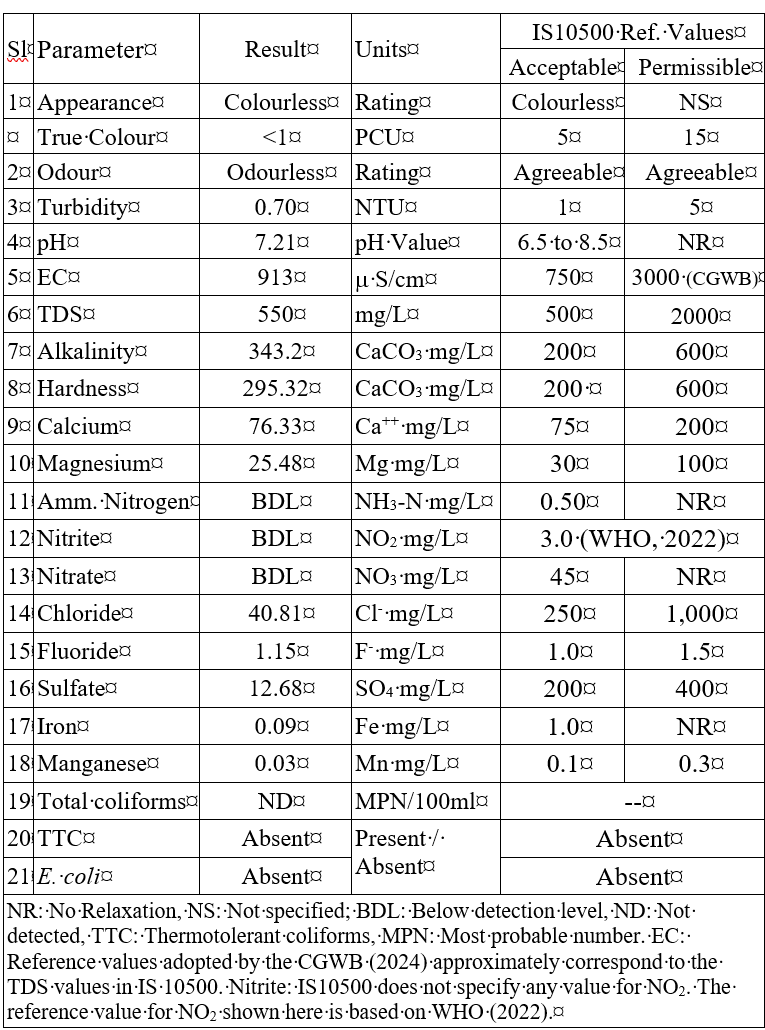
This is a case where physical and sensory characteristics as well as tested general chemical parameter values were within acceptable/permissible limits. No coliform was detected in the bacteriological analysis, indicating no faecal contamination. Laboratory personnel found the sample odourless. However, there is a possibility that the smell of freshly extracted borewell water observed onsite by the consumers might have dissipated in the course of collection, storage, and transportation to the laboratory. Hence, the opinion about the potability of the borewell water was withheld, and the following opinion was provided to the client.
It would be desirable to monitor trend of smell observed by the client. The smell of freshly extracted borewell water observed by client may have dissipated from the sample during collection and storage. Hence laboratory observation of smell is to be interpreted in conjunction with smell observed by users.
Cases in which unfit for drinking or cautious monitoring opinion was given based on rating of colour and/or odour coupled with consumer observations, even if all other tested parameters were within IS 10500 acceptable/permissible limits:
Case-03, Foul smelling borewell water:
A resident noticed that her borewell water had a sewage-like smell and sometimes appeared black and foul. The family uses this water for general purposes. She collected a sample directly from the borewell delivery pipe into two empty packaged water bottles and sent it for testing. The client did not provide any information regarding the age, depth, or pump capacity of the borewell, the surrounding environment, or any intermediate storage arrangements. The laboratory units reported following results:
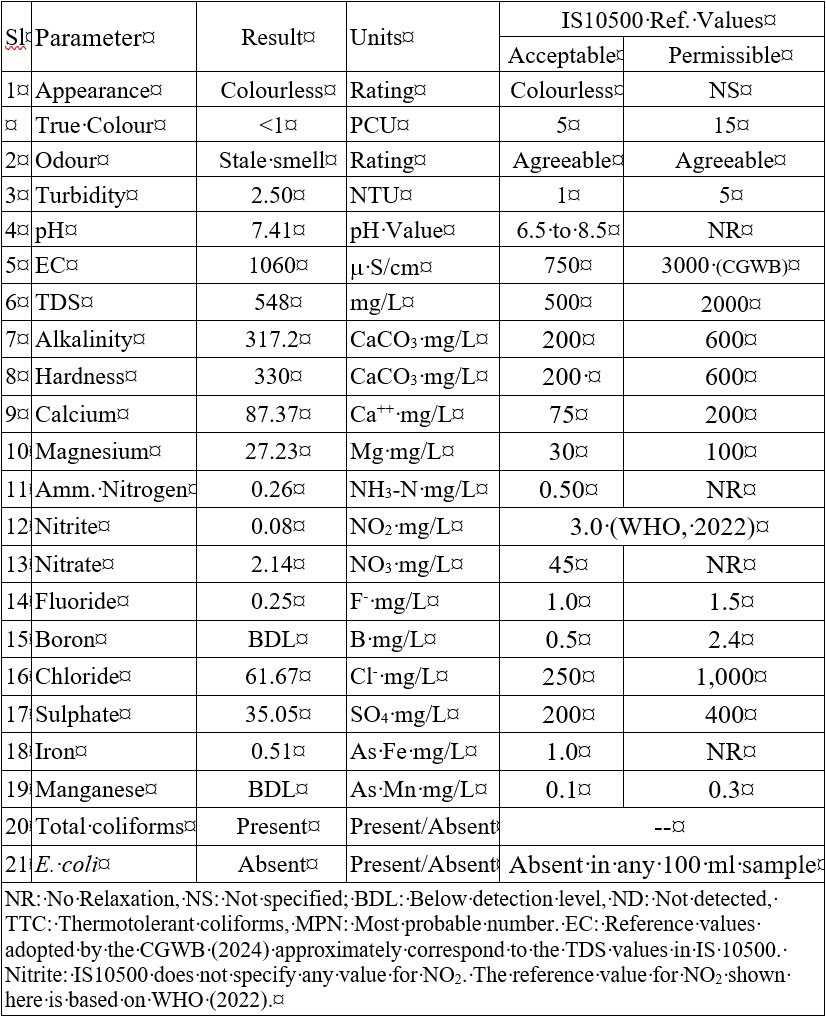
This is a case where physical and sensory characteristics, as well as tested general chemical parameter values, were within acceptable/permissible limits. There was no sign of faecal contamination as microbial culture did not detect any E. coli. Laboratory personnel reported its odour as a 'stale smell' but did not sense it as foul. This finding was inconsistent with the client's report of a sewage smell and dark appearance of the water. Consumer perception of a foul smell should not be rejected on the basis of a single laboratory test. It would be desirable to repeat the test, along with more detailed information about the age, depth, pump capacity, and surroundings of the borewell. Photo documentation of the borewell, its surroundings, and the sample collection point would be helpful. The following opinion was provided to the client:
Prima facie, the water appears suitable for general use. Although bacteriological analysis did not show any sign of faecal contamination, this water should not be used for drinking in view of consumer reports of foul smell.
Case-04, Chemical smell in borewell water:
A household collected a sample of borewell water in an empty packaged water bottle and sent it for analysis. The family had noticed a chemical smell in the water and wanted to find out if the water was contaminated.
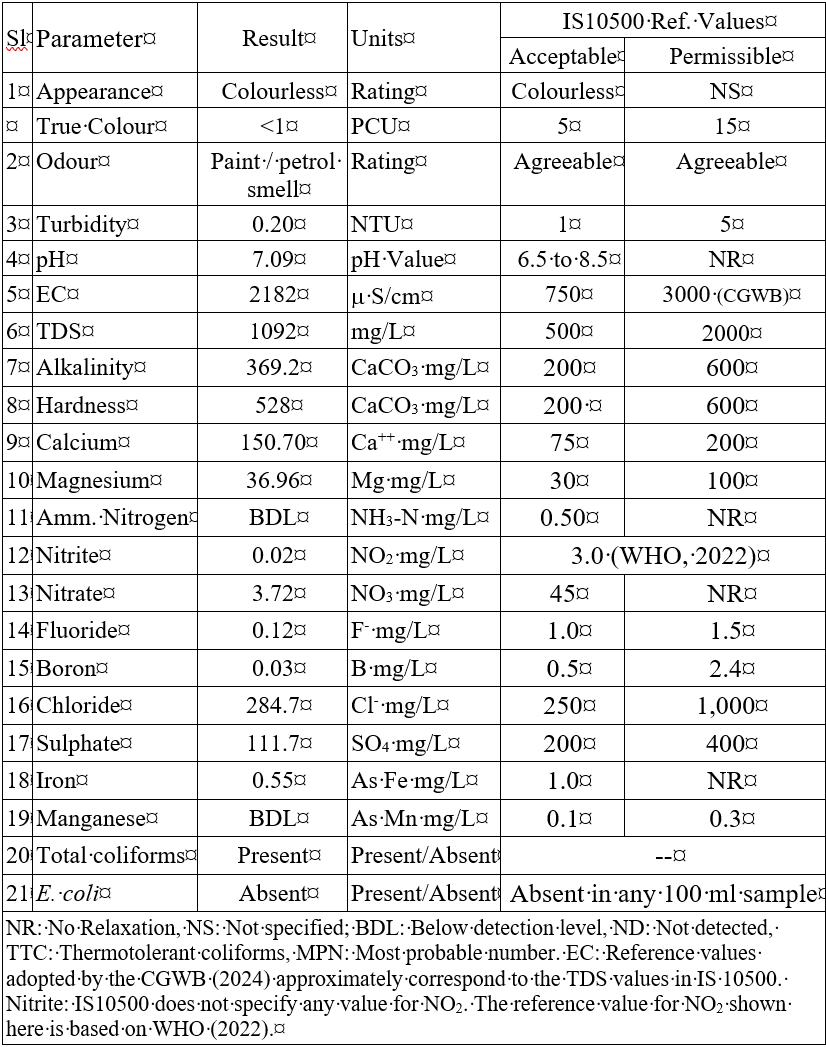
This is a case where 4 out of 7 members of an expanded smell panel reported a petroleum smell and the remaining 3 reported a paint smell. All other physical, sensory, and general chemical parameter values were within the acceptable/permissible limits. Bacteriological analysis did not show any sign of faecal contamination. The following opinion was provided to the client:
The water is unfit for drinking in view of petroleum/chemical smell.
Case-05, Drainage Pollution in Borewell Water:
A household wanted to check if their borewell was polluted with wastewater. The 10-year-old borewell was about 550 feet deep. A sample was collected from the delivery pipe into an empty packaged water bottle. The laboratory units reported following results:
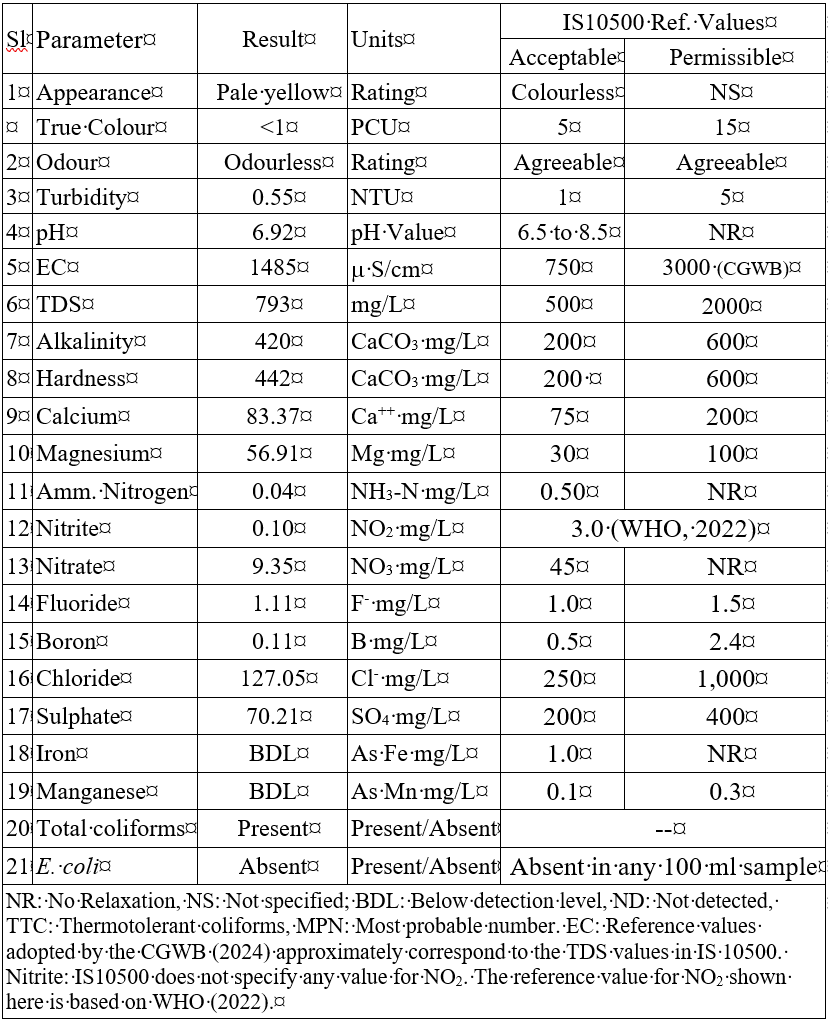
The test results of this sample were within acceptable and permissible limits for human consumption. A bacteriological analysis did not detect E. coli, indicating no faecal contamination. However, the pale-yellow appearance of the unfiltered sample and traces of ammonia detected in it could be due to surface water intrusion. The following opinion was provided to the client:
As of now, there is no evidence of faecal contamination. However, it would be advisable to repeat tests at intervals of say one month and watch for emerging contamination if any.
Go TopReferences:
- GOI-DDWS, 2004. Community Based Water Quality Surveillance, Chapter-10 in Implementation Manual on National Rural Water Quality Monitoring & Surveillance Programme. New Delhi: Govt of India Ministry of Rural Development, Dept of Drinking Water Supply (DDWS); 2004 Nov.
- GOI-MoDWS. Annex.D, p41 in National Rural Drinking Water Programme - Guidelines. New Delhi: Govt of India Ministry of Drinking Water & Sanitation (MoDWS); 2013. Available at https://www.ielrc.org/content/e1308.pdf
- GOI MoDWS, 2013. Uniform Drinking Water Quality Monitoring Protocol. New Delhi: Govt. of India Ministry of Drinking Water and Sanitation (GOI MoDWS); 2013 Feb.
- GOI-DDWS. 2021. Basic water quality parameters, p14 in Drinking Water Quality Monitoring & Surveillance Framework. New Delhi: Govt. of India Ministry of Jal Shakti, Department of Drinking Water and Sanitation (GOI DDWS); 2021 Oct.
- CPHEEO, 2023. Ch-8.4.3.2&3, pages 301-304 in Manual on Water Supply and Treatment Systems Part B - Operation & Maintenance. New Delhi: Ministry of Housing and Urban Affairs, Govt of India (MOUD) - Central Public Health and Environmental Engineering Organization (CPHEEO); 2023 Dec; 2nd Ed. Available at https://mohua.gov.in/upload/uploadfiles/files/Part-B-Manual-Operation-and-Maintenance(4).pdf
-------------

To pick up sample collection bottle and/or schedule collection of samples: Email: ihslab@ihs.org.in with your address and contact telephone; OR WhatsApp: +919848011251; Or Call: 23211013/4.